Using Good Stories to Reimagine Professional Learning
BY ANN PELO AND MARGIE CARTER
Stories are powerful. They tell us who we are and who we can become. They locate us in human community and in the wide, wild world.
In the context of our lives as educators, the central questions about stories are: What stories do we want children to hear about themselves? What kind of storytellers do we want to be? What ideas and values do we want to call forward in our stories?
We are shaped by the stories we tell, as much as children are shaped by the stories we tell about them. Stories make us, all of us—the story tellers, and the people who the stories are about, and the people who hear the stories. The stories that we share speak volumes about who we want to be and the community that we want to nourish.
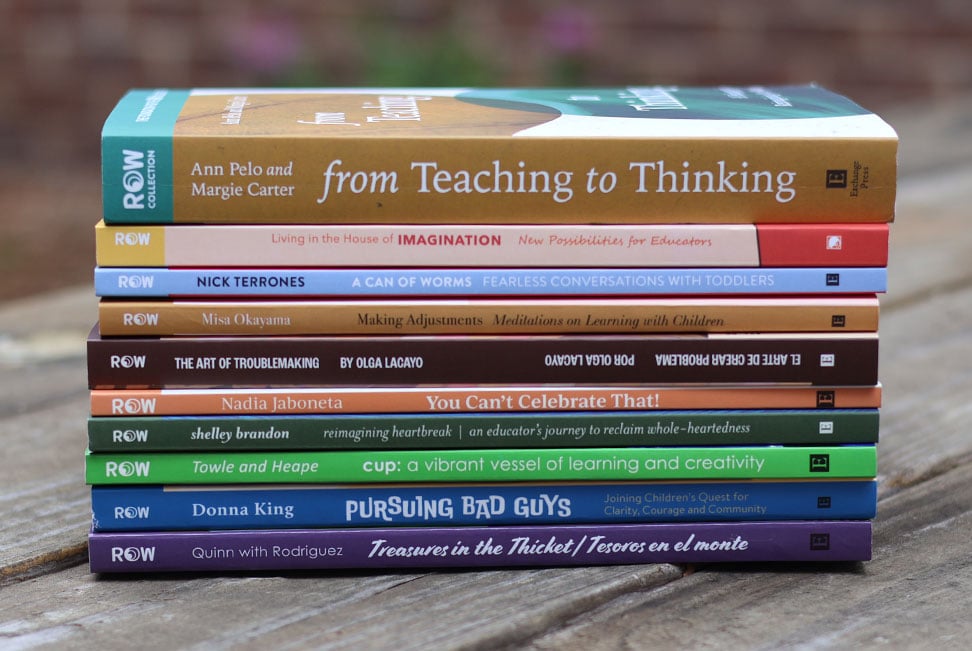
Reflect: How might you use the stories in the ROW (Reimagining Our Work) collection during staff professional development, in your college courses, or for personal reflection? As the authors ask, how can you continue to open yourself to discoveries that will change you?
ADVERTISEMENT
AI Gives Early Childhood Leaders Room for What Matters Most!
BY KAREN FOSTER-JORGENSEN
Early childhood leadership has always required heart, judgment, courage, and an enormous amount of invisible work. Directors and administrators carry staffing concerns, family questions, compliance requirements, financial pressures, enrollment details, classroom needs, board expectations, and the emotional pulse of the organization—often all in the same morning.
So, when artificial intelligence enters the conversation, it is understandable that early childhood leaders may pause. Is this another thing to learn? Another trend to evaluate? Another tool that promises to make life easier while quietly adding more complexity?
Perhaps the better question is not whether AI belongs in early childhood leadership, but how it might be used wisely, ethically, and humanely.
Reflect: There are conflicting feelings about AI in today’s world. How did you feel about this article? Were there suggestions you found helpful?
ADVERTISEMENT
Inclusion Beyond Compliance: Belonging as an Ethical Practice in Early Learning
BY JINAH KIM
Inclusion is widely named as a value in early childhood education and care, but it is not always experienced as a reality by children with disabilities and their families. A child may be enrolled in a program and still not be fully welcomed. A care plan may be written and still not be understood. A program may meet minimum regulatory expectations and still fall short of creating the conditions where a child can participate with dignity, relationships and belonging. For early childhood educators and child care leaders, this gap between compliance and belonging deserves careful attention.
This article argues that inclusion in early childhood education and care must be understood as an ethical and children’s rights responsibility, not simply as an optional program choice or an individual accommodation. Educators’ perceptions of disability, their professional training and their direct experiences with children with disabilities shape whether inclusion becomes meaningful practice. When inclusion depends only on individual comfort, program capacity or available resources, children with disabilities remain vulnerable to conditional participation and exclusion.
Reflect:What do you believe are some of the most important factors in helping ECE programs move their inclusion practices from simple compliance to true belonging?
Exchange Community Voices IS MADE POSSIBLE BY OUR DEDICATED SPONSORS:
Exchange Community Voices is brought to you by our Exchange Staff with Nancy Rosenow as Editor-in-Chief. Our collaboration with Exchange Strategic Partners supports early childhood professionals worldwide.
FOLLOW US
This email was sent to _t.e.s.t_@example.com by
Dimensions Educational Research Foundation, 7700 A Street, Lincoln, Nebraska 68510, United States (800) 221-2864 | info@exchangepress.com