|
|
|
|
Exchange Magazine's Weekly Digest • Volume 1, Issue 26 • June 29, 2026
|
|
|
|
|
|
|
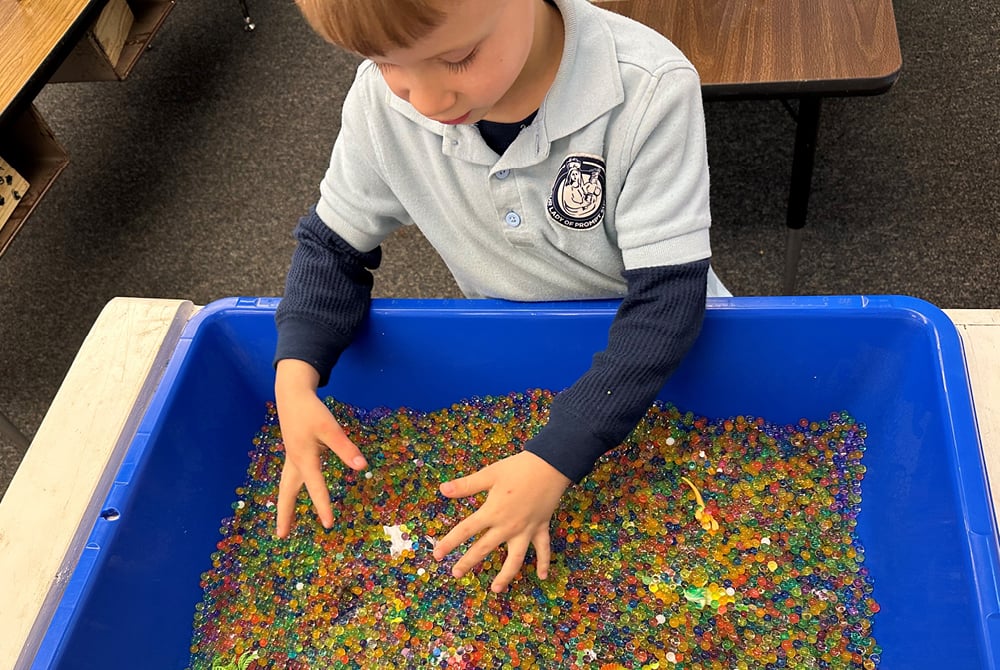
Facilitating Early Learning Experiences through Sensory Play
|
|
|
|
|
BY MICHELLE FAZIO-BRUNSON, CYNTHIA DICARLO, MARTHA HOPEWELL, DEBRA JO HAILEY
|
|
|
Young children learn best through direct experiences in their immediate environment (Bartan & Alisinanoğlu, 2024; LaForett et al., 2023). One example of a developmentally appropriate play-based experience is sensory play. “Sensory play is any activity that stimulates our senses—touch, sight, hearing, smell and taste. It helps children interact with and make sense of the world that surrounds them” (Action for Children, 2024, para. 2). Sensory play is especially valuable in early childhood classrooms because it allows educators to intentionally integrate science, technology, engineering, art, and mathematics (STEAM) concepts within developmentally appropriate play experiences.
When teachers thoughtfully design sensory environments and materials, children are able to explore ideas, test hypotheses, and build understanding through active investigation. By manipulating developmentally appropriate three-dimensional materials during sensory play, children build creative and critical thinking skills, develop language as they interact with peers and describe their experiences, learn to share, develop self-regulation and body control, strengthen problem-solving skills, and build understanding of symbols in their environment (Kao et al., 2025). Each of these experiences helps preschoolers lay a foundation for working effectively with others, solving problems, comprehending what they read, and sharing new knowledge through writing in later grades and throughout life (ZERO TO THREE, 2016; Zhan et al., 2025).
READ THE ARTICLE >>
|
|
|
Reflect: The authors provide examples of easily accessible, low-cost materials that lend themselves to sensory exploration experiences. Are there some of these materials you have not yet tried with children and would like to? What sensory materials work especially well in your setting?
|
|
|
|
|
|
|
|
|
|
|
|
|
Technoference and Tantrums: What’s the Connection?
|
|
|
|
|
Technology plays an essential role in enabling human contact, collaboration, and learning. For parents, technology enables connection with others and access to essential resources (Komanchuk et al., 2023). When it comes to the developing brain, however, we must proceed with caution. As early childhood educators and experts, we must be aware of the potential impact of mobile technology (i.e., cell phones and tablets) on emotional regulation—a foundational competency that impacts every aspect of healthy development.
Emotional regulation is a foundational skill that underpins human learning and can have wide-ranging effects across the lifespan. The capacity to regulate one’s own emotions forms the basis for learning and cooperative interaction, and is connected to positive social development (Keenan, 2000). Emotional regulation is broadly defined as the ability to monitor, modulate, and modify emotional expressions and experiences (Gross, 2015; Keenan, 2000; Lowe et al., 2012).
The capacity for emotional regulation begins in infancy and is developed through participation in cycles of affective signaling (the act of reading and responding to another’s emotional signals) with a caregiver (Tronick, 1989). The caregiver aids the infant in achieving a goal (such as obtaining something out of reach) by carefully attending to the baby’s messages and responding to her communicative intent. Because the caregiver responds before an instinctive behavioral response such as crying (fight) or withdrawal (flight) begins, the baby stays calm and available for learning—emotionally regulated.
READ THE ARTICLE >>
|
|
|
Reflect: The author writes about “technoference”—the term used to describe interruptions in communication between adult and child, caused by phone or tablet use. How might you share information about this serious issue—with families, with educators, with college students?
|
|
|
|
|
|
|
|
|
|
|
|
|
|
|
From the pandemic to economic crises, Christian early education school leaders are facing unprecedented challenges. News streams regularly confront us with increasing developmental delays and students with disabilities, school shootings, fluctuating enrollment, teacher burnout, teacher shortages, financial challenges, natural disasters,
|
|
|
|
|
|
racial tensions, the need to pursue multiple revenue streams, and the weariness of school leaders. Fostering sustainability, competitive advantage, flexibility, and adaptability are more important than ever. But what does this mean for Christian early education?
VUCA – Understanding in a Complex World
The term VUCA was developed in the 1990s and stands for “volatility,” “uncertainty,” “complexity,” and “ambiguity.” Originally used by the U.S. Army War College for reorientation after the Cold War, it has since found its way into the management strategies of successful companies and is taught at renowned business schools.
READ THE ARTICLE >>
|
|
|
Reflect: While the author is writing specifically for Christian early education programs, how might some ideas in the article, such as the VUCA Model (Volatility, Uncertainty, Complexity, Ambiguity) be helpful to any early education leader?
|
|
|
|
|
Exchange Community Voices
IS MADE POSSIBLE BY OUR DEDICATED SPONSORS:
|
|
|
|
|
|
|
|
|
|
|
Exchange Community Voices is brought to you by our Exchange Staff with Nancy Rosenow as Editor-in-Chief. Our collaboration with Exchange Strategic Partners supports early childhood professionals worldwide.
|
|
|
|
|
|
|
|
|
|
|
|
|
This email was sent to _t.e.s.t_@example.com by
Dimensions Educational Research Foundation, 7700 A Street, Lincoln, Nebraska 68510, United States
(800) 221-2864 | info@exchangepress.com
Exchange Press is a program of Dimensions Educational Research Foundation, a 501(c)3 non-profit organization.
Copyright © 2026 Dimensions Educational Research Foundation, All rights reserved.
|
|
|
|
|
|
|
|
|