Scaffolding Without Taking Over: Why Shared Control Matters in Early Learning
BY HEMA KHATRI
In early childhood classrooms, some of the most important teaching moments happen in just a split second, like when children look to an adult for help.
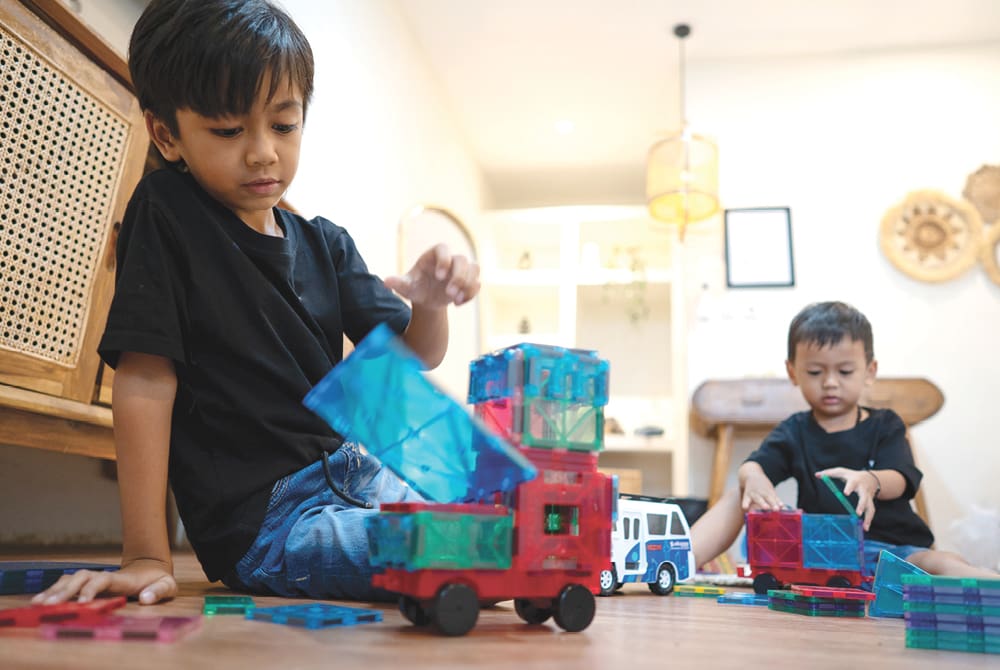
Three children were building with Magna-Tiles. Mason was standing in the center while his friends constructed walls around him. I stayed nearby, observing but not stepping in.
One child said, "Mason is tall. We need more tiles."
Another asked, "How many?"
Then they both looked at me.
That glance wasn’t just about counting. It was about ownership. Who was in charge of this project? I felt the urge to jump in and give them a quick answer. It would have been easier. But instead, I paused and asked, "How could you figure that out?"
They began counting the tiles already in place and comparing the wall’s height to Mason’s shoulders. They discussed whether it should reach his head. They adjusted, recounted, and tested again.
The math came from their curiosity, not my explanation.
This is the difference between helping and taking over.
Reflect: How would you define the phrase "shared control," and how does it show up in your work?
ADVERTISEMENT
Seeing Children Into Existence: Ways You Can Advocate for Children and Families in ICE Detention
BY GALE HALL
Did You Know
that 6200 children were booked in ICE detention since January of 2025 including children as young as infants and toddlers? Their average age is 7, and the average stay is 6 months. (Marshall Project; CBS News; Border Report; Propublica)
I retired from a fulfilling and joyful career in early childhood education in 2016 and moved from New Hampshire to southern Arizona. Friends asked if I would be safe. Politicians and the media had created the myth of an invasion of criminals at the southern border. But I had visited and knew it wasn’t true. A Welcome Center in Tucson sheltered up to 300 people seeking asylum daily. Newcomers received food, fresh clothes, a place to sleep and help in contacting their sponsors who would pay for their transportation to join them. Walking down this road in Tucson, there was no evidence that asylum seekers were staying there. The myth of dangerous criminals from insane asylums roaming our streets was false. These were mostly young families who had followed the law which required them to be physically present in the US to apply for asylum. They were transferred to the Welcome Center by Border Patrol after passing their credible fear interviews while in detention and were now getting ready to transition to their new communities.
In the fall of 2018, some friends and I started to make quilts for children staying at the Center. We wanted children to feel special and welcomed in their new country. The Welcome Center had an art room where children could relax and draw. The trauma-informed program asked the children to draw what they loved. When the volunteers departed for the evening, some children drew the stories of why they left home, their journeys, and being at the border.
There are moments, quiet, often unnoticed, where the future is being decided. A question asked is answered or silenced. A person invited to explore or instructed to comply. A felt intuition honored or denied and ignored. These moments are where power is practiced, where imagination is either expanded or constrained, and where possible futures are either cultivated or foreclosed.
We often think of fascism as something distant, historical, political, overt. Yet its logic appears in subtle, everyday ways: in systems that prioritize control over curiosity, uniformity over difference, obedience over relationship, all while using fear as its primary messenger. At its core, fascism narrows imagination.
Anti-fascism, then, is not only resistance, it is creation. It is the intentional work of expanding possibility, distributing power, and cultivating environments where people can imagine and build something different together.
Early childhood learning environments, and emergent learning approaches, are not simply pedagogical frameworks; they are living examples of this work. They show us what it looks like to design for freedom, and in doing so, offer a blueprint for resisting systems rooted in control.
Reflect:The authors write, "Every day, leaders within the early care and education sector have the opportunity to embody a futurist orientation that asks: ‘What future would we be proud to help create?’" How would you answer that question?
Exchange Community Voices IS MADE POSSIBLE BY OUR DEDICATED SPONSORS:
Exchange Community Voices is brought to you by our Exchange Staff with Nancy Rosenow as Editor-in-Chief. Our collaboration with Exchange Strategic Partners supports early childhood professionals worldwide.
FOLLOW US
This email was sent to _t.e.s.t_@example.com by
Dimensions Educational Research Foundation, 7700 A Street, Lincoln, Nebraska 68510, United States (800) 221-2864 | info@exchangepress.com