BY PRESTON BLACKBURN, CONTRIBUTED BY COMMUNITY PLAYTHINGS
What Every Wiggly, Crashing, Shutting-Down Child Is Trying to Tell You
You know the child. Maybe you’ve taught one. Maybe you’ve raised one. Maybe you, if you’re being honest, are a grown-up one.
She can’t stop touching things. She bumps into classmates, knocks over her cup, and seems to have no idea how hard she’s hugging the dog.
He spins in circles for what feels like hours, crashes headfirst into the couch cushions, and craves jumping on everything. Or maybe he’s the opposite: hesitant on the playground, refusing to swing, melting down in a loud gymnasium, plugging his ears in the grocery store.
These children are not misbehaving. They are not defiant. They are not “just like that.” Their bodies and brains are working harder than most of us realize, and they are desperately using the tools available to them to feel okay.
And those tools—the crashing, the spinning, the avoiding—are movement. Or the lack of it.
Reflect: The author writes, “Taking recess away from the child who can’t sit still is like taking glasses away from the child who squints.” Read the full article to learn many helpful techniques for supporting sensory-seeking or sensory-avoidant children. And consider who might benefit if you share this article with them.
ADVERTISEMENT
Bewildering, Unifying, Glowing Complexities: Early Childhood Life and “What Happened There”
BY MICHELE HEMENWAY PULLEN AND KISA MARX
A quote from Douglas Main, National Geographic:
“Exactly how the fireflies coordinate their signaling and achieve synchrony remains a mystery. The insects can signal at roughly the same time across a wide area, even though they can only see the individuals within a short distance of themselves. Somehow that’s enough to have everybody on the same page,” [physicist Raphael] Sarfati says. “They somehow set their own personal clock at the same pace as the rest of the group. Synchronous phenomena are vital to life as we know it, from the coordinated contractions of the heart to the firing of neurons in the brain. Models have been created by physicists such as Steven Strogatz, who studied the insects and marveled at their ‘bewildering complexity,’ as he put it. One aspect of the complexity: Every species is quite different.”
From Michele:
On a Saturday in February 2024, I first saw the name Kisa Marx in a message on a Zoom meeting screen during the Defending the Early Years orientation for their “Working Groups” cohorts. Led by Denisha Jones, Executive Director, the question posed by Defending the Early Years was: Can a group of early childhood professionals work together in their communities to influence local policy in the area? The working groups were co-facilitated in several states, Illinois being one of them. Hans Petersen, my husband, and I were leading from Kentucky. Kisa’s message shared that she would be unable to manage attendance as some water pipes had burst and she was in the middle of managing that instead!
Since that time, an unraveling and reweaving of the yarn we did not know connected us has been noteworthy in the ongoing “stories from the field” library.
Reflect: The authors use the metaphor of the unified glow of the light of fireflies to represent the things that bring us hope in the early childhood field. Where are you finding moments of light that give you hope?
ADVERTISEMENT
Lessons From an 86-Year-Old Anti-Bias Educator
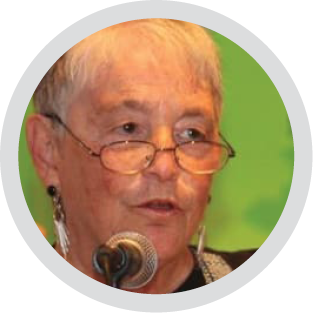
BY LOUISE DERMAN-SPARKS
“We need all the different kinds of people we can find to make Freedom’s dream come true. So as I learn to like all the differences in me, I learn to like the differences in you. I like you, no doubt about it. You like me., can’t live without it. We are free. Let’s shout about it. Hooray for Freedom’s Child!” –Bill Martin
These words, from one of my favorite children’s picture books, illuminate why I have been an anti-bias/social justice educator all my professional life. Here are ten lessons that have helped me sustain my work.
Background/Context
National Association for the Education of Young Children (NAEYC) first published Anti-Bias Curriculum: Tools for Empowering Young Children in 1989. (Derman-Sparks & the ABC Task Force) and then published two further revisions in 2010 and 2020– Anti-Bias Education for Young children and Ourselves (Derman-Sparks & Edwards). Numerous ECE professionals in the USA and internationally (teachers of children, families, and college students, directors/managers of ECE programs and agencies) have embraced anti-bias education’s principles and goals . These are implemented in ways that reflect each country’s history, cultures, and societal dynamics.
Reflect:Which of Louise Derman-Sparks’ ten “Lessons for Keeping On” did you find especially helpful?
Exchange Community Voices IS MADE POSSIBLE BY OUR DEDICATED SPONSORS:
Exchange Community Voices is brought to you by our Exchange Staff with Nancy Rosenow as Editor-in-Chief. Our collaboration with Exchange Strategic Partners supports early childhood professionals worldwide.
FOLLOW US
This email was sent to _t.e.s.t_@example.com by
Dimensions Educational Research Foundation, 7700 A Street, Lincoln, Nebraska 68510, United States (800) 221-2864 | info@exchangepress.com